Where Would I Be…?Product story · 4 min read
Where would this place be as the plates move?
An interactive globe that lets a chosen place move with a plate-motion model and makes the model’s limits part of the story.
Read the case study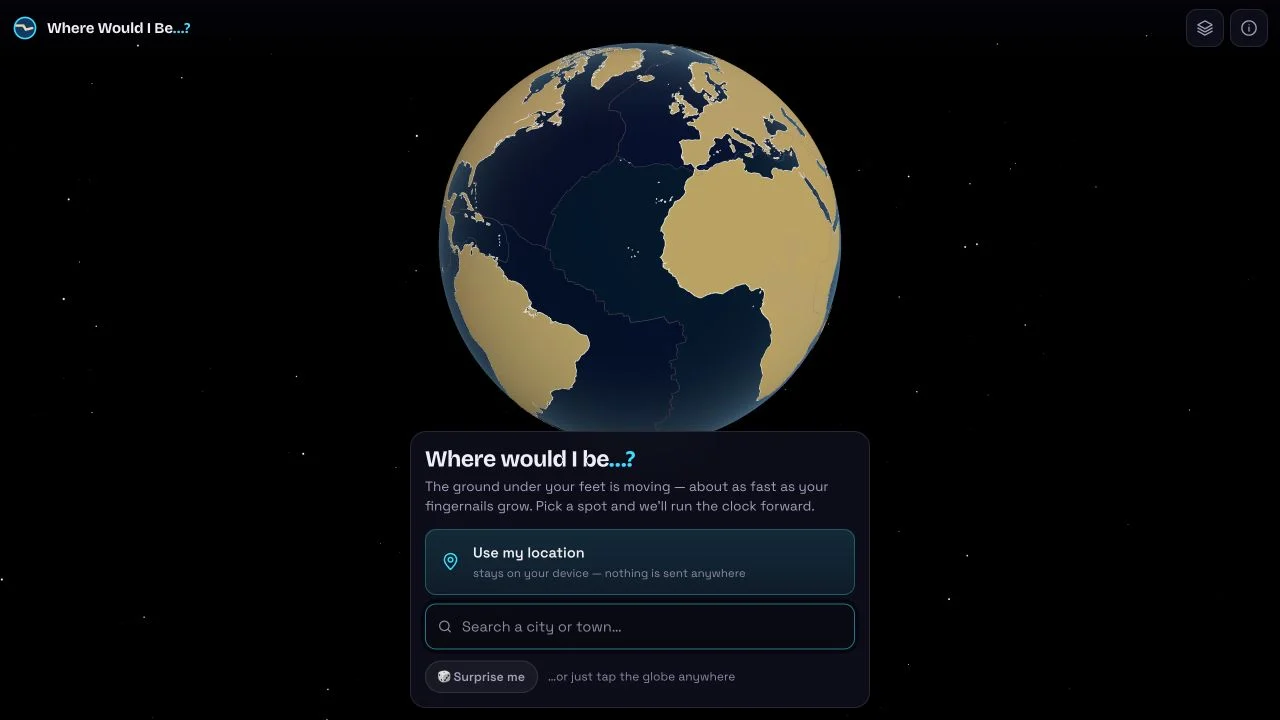
Original location entry screen. Choosing a place starts the exploration of plate motion through time.
View full size ↗01 The problem
How can a compelling journey keep the model’s limits in view?
Plate motion is slow enough to be invisible in everyday life and large enough to reshape a world over time. This project gives that scale a personal anchor: choose a place, move the clock, and follow the ground beneath it.
Designed for Curious visitor exploring deep time. Follow a place through time and understand what the model means.
User context Design assumption
Using a familiar location to make plate movement tangible.
- The friction
- A smooth moving globe can look more certain than an extrapolation is.
- Design implication
- Keep the model qualification near the time result.
Example situation · illustrative scenario. Imagine following the patch of crust beneath a familiar place over a time span you cannot experience. One personal point of reference gives deep time somewhere to begin.
02 The direction
A personal anchor for deep time
A smooth animation is still conditional. Holding present plate velocities constant creates an extrapolation whose limits grow with the horizon.
Product artifact · model and interaction sequence
My direction. I kept the globe clear, began with a place, and let the time control reveal a concise answer before offering deeper detail.
Process and product scope
I gave the opening one task: choose a place. A time control and a short result then introduce motion, with optional detail kept out of the main globe.
The visual story needs to carry its qualification with it. Constant-motion extrapolation can invite exploration, but the result should not read as a reconstruction or prediction of the continents.
- 1
- place-led starting question
- Progressive
- details on demand
- Modelled
- extrapolation, not prediction
- Anchor
Start from one familiar location.
- Explore
Move the time control and follow its path.
- Understand
Read the result alongside the model’s assumptions.
03 Design decisions
Keep each prediction’s limits visible.
Open a decision to see the reasoning and trade-off.
01Give each stage one main task
Choose a place first, then explore time, with optional comparison later.
Why this matters. A clear sequence can make a complex subject approachable without presenting every control at once.
The trade-off. Progressive disclosure should not hide the model’s most important qualification until after someone has formed a false impression.
02Protect the space where the answer is drawn
The design keeps the main globe clear and groups controls in a bottom dock.
Why this matters. The selected point and its path are the explanation; a floating panel over them would compete with the result.
The trade-off. A dock must adapt to available height so it does not consume the same space on a small screen.
03Make the scientific boundary legible
The source describes plate movement as a constant-motion extrapolation with increasing limits over long horizons.
Why this matters. Personal storytelling can encourage exploration without claiming to know the future shape of continents.
The trade-off. A smooth animation can still imply certainty, so the qualification belongs near the time result.
04 The outcome
A point through time, with the model in view.
I used a chosen location as the starting point for exploring time on the globe. Time controls, comparison and optional layers support the exploration, while the model limit stays near the result. The long-term path is an extrapolation, not a geological forecast.
More about the experience
- A personal anchor. The selected point connects a large timescale to a familiar location.
- Details on demand. The interface leaves the globe room to explain the path.
05 Reflection
Let the story invite exploration without turning a model into a prediction.
I would ask someone to explain why the point moves and why the long-term path is conditional. The interaction should leave them with a useful question about plate motion, not misplaced confidence in a prediction.
What I would evaluate next proposed work
- ask a visitor to describe what changed and what assumptions the model makes after a short exploration.
- narrow-screen globe visibility, reduced-motion behaviour, keyboard interaction, and whether uncertainty stays visible at extreme dates.
A home for my writing, in the form it needs.