The Office GamesProduct story · 4 min read
Get everyone in. Keep the round moving.
A team-trivia experience exploring quick room entry, visible roles, and shared game state for a short social break.
Read the case study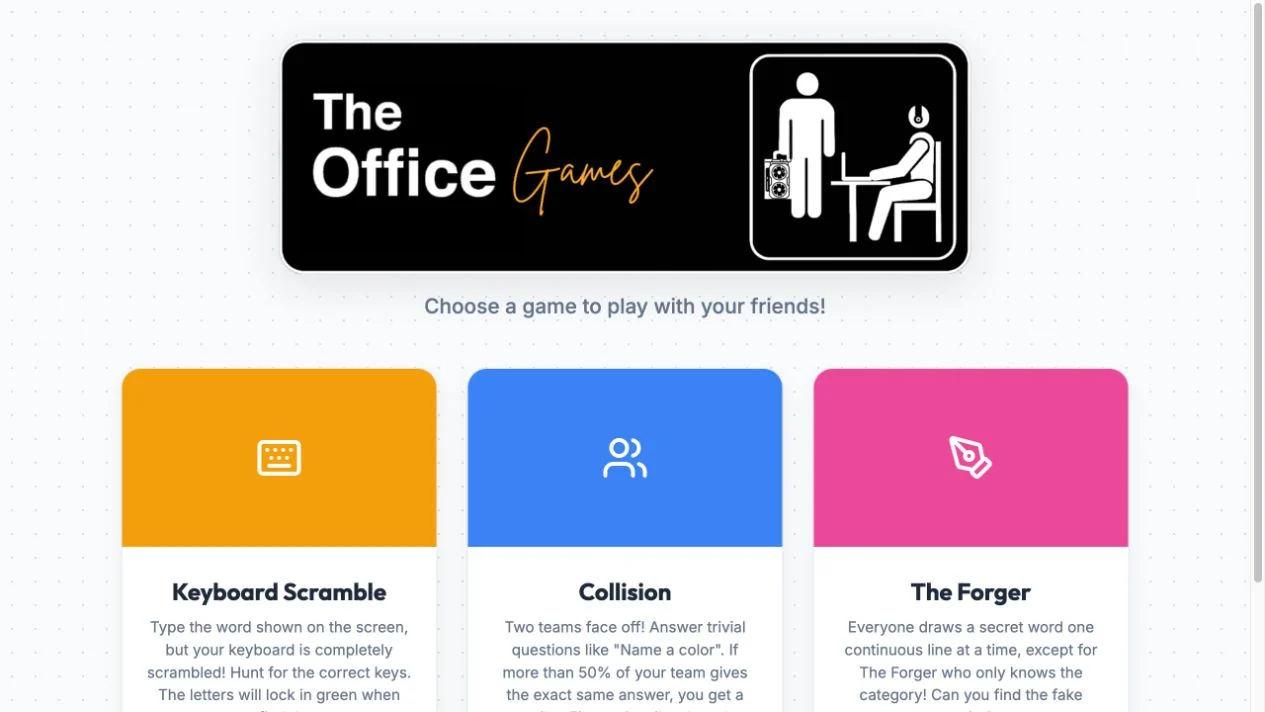
Original Office Games entry screen. A group chooses a game before joining a shared room.
View full size ↗01 The problem
What does the group need to understand at every handoff?
A short team game loses momentum when people are unsure how to join or whose turn it is. The reviewed Office Games module centres on a simple room flow, a lobby, team roles, and a visible answering/stealing sequence.
Designed for Colleague joining a short group game. Join quickly and know whose turn it is.
User context Design assumption
Entering a room and learning a team role during an office break.
- The friction
- Waiting and role changes become confusing when the interface is silent.
- Design implication
- Make room, role, and next action visible.
Example situation · illustrative scenario. Imagine a short team break being spent explaining how to join, who can answer, and why the game is waiting. The social rhythm depends on those transitions being obvious.
02 The outcome
A room with a shared social rhythm.
For the trivia flow documented here, I focused on room entry, teams, scores and the answering-and-stealing sequence. The interface gives the group a shared view of who can act next. Local demo mode and connected play need different expectations.
More about the experience
- A social entry point. The product offers a quick route into a shared game.
- Reviewed scope: trivia. Local demo and network-backed play make different connection promises.
03 The direction
Someone needs the next turn
Shared state has to become shared understanding. Room entry, team roles, and the answering/stealing sequence all contribute to the pace.
Product artifact · reviewed trivia module
My direction. I focused the reviewed trivia module on a concise joining path and visible responsibility through each round.
Process and product scope
I mapped the reviewed trivia journey from joining a room to understanding teams, turns, answering, and stealing. The broader games catalogue is outside the evidence available for this case study.
The UX needs to explain the connection mode before a group commits to a game. Trying a local demonstration and joining colleagues on separate devices are different experiences.
- 4
- letters in a room code
- Team-based
- turn and score model
- Explicit
- local or network mode
- Join
Use a short code and a player name.
- Orient
See the teams and who can act.
- Play
Follow the answering and stealing sequence.
- Continue
Keep scores and waiting states understandable.
04 Design decisions
Make the next turn clear to everyone.
Open a decision to see the reasoning and trade-off.
01Make joining a small action
A four-letter room code and a player name provide a concise entry path.
Why this matters. A social break should spend more of its time playing than explaining setup.
The trade-off. A short code still needs clear invalid-room and full-room handling, and does not establish secure identity.
02Expose responsibility in the game state
The interface distinguishes answering and stealing teams, active players, and scores.
Why this matters. People need to see who can act and why the round is waiting.
The trade-off. Role-based interaction becomes confusing if waiting states or connection loss are not explained.
03Keep connection mode understandable
The setup distinguishes a local demonstration from connected play.
Why this matters. A demo can help someone try the game, but should not promise multi-device play it cannot provide.
The trade-off. A connected game needs clear waiting, conflict, reconnection, and host-recovery states.
05 Reflection
A social game moves when everyone knows what happens next.
I would run a short session and pay attention to the pauses: joining, waiting for a team, recovering a connection and changing the host. The answer screen is only one part of whether the break feels easy to join.
What I would evaluate next proposed work
- run a short trivia session with several participants and record setup explanations, confused turns, and waiting time.
- separate-device joining, reconnection, duplicate actions, host departure, and a clearly labelled local demo mode.
Health readings with the context attached.