BNI GoaDesign study · 4 min read
Meet the chapter. Know how to take part.
A chapter-website concept that connects the organisation’s purpose, the people behind it, and a first visit.
Read the case study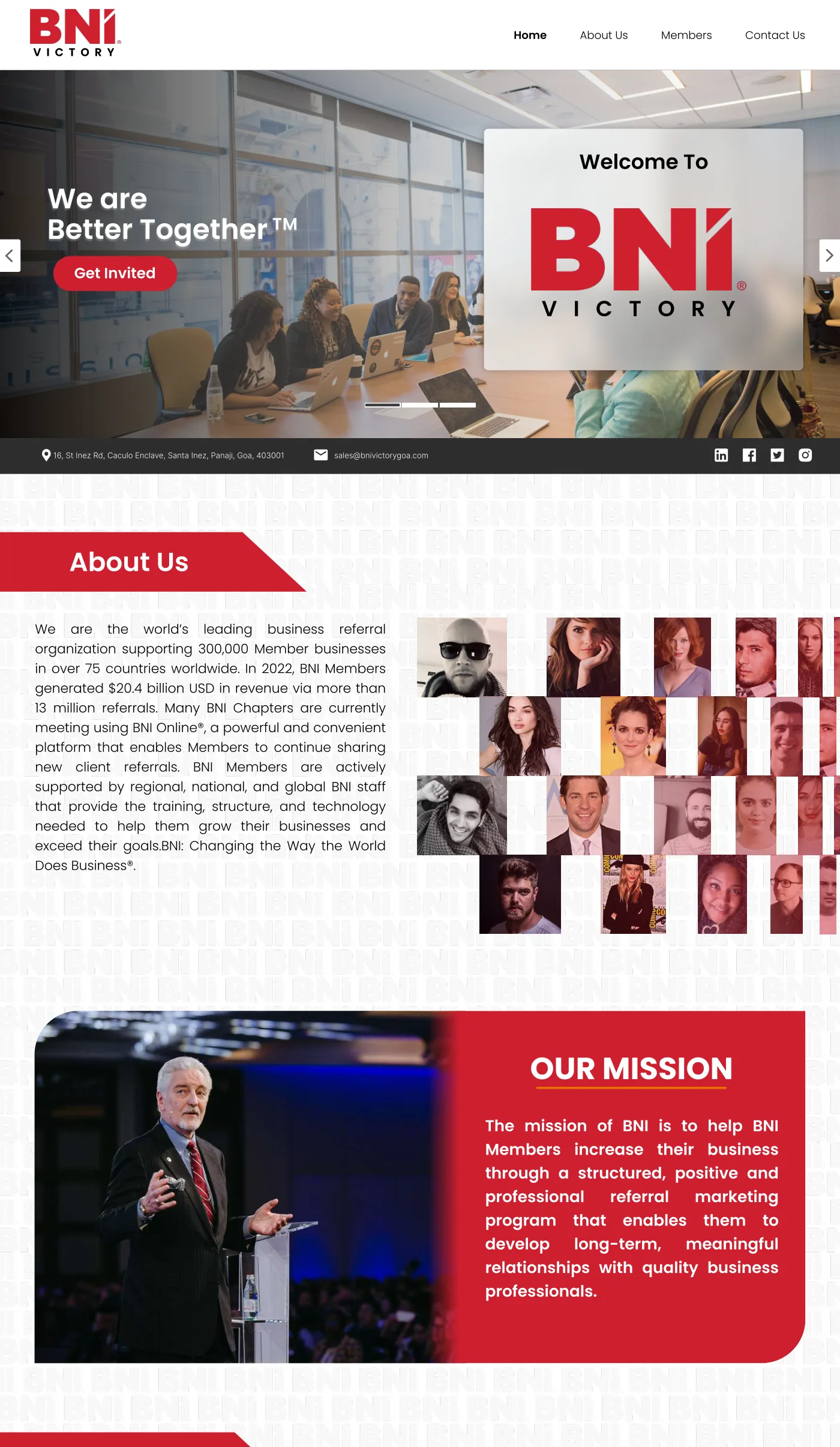
The original chapter introduction connects the invitation to a purpose-led overview.
View full size ↗01 The problem
What turns an organisation overview into an approachable first visit?
A person considering a business network needs to understand its purpose, who participates, and how to take a first step. The BNI Victory Goa design brings those questions into a local chapter website with an invitation, organisation overview, leadership section, member directory, and contact form.
Designed for Business owner exploring a local chapter. Understand local people, purpose, and the next step.
User context Design assumption
Considering whether the network is relevant and how to participate.
- The friction
- Global organisation information does not answer local membership questions.
- Design implication
- Bring the chapter’s people and participation path forward.
Example situation · illustrative scenario. Imagine considering a business network for the first time. You want to understand who participates, why they meet, and whether you could take a first look without already knowing someone.
02 Research & direction
What a chapter must explain
The chapter concept gives the visitor a purpose, people, and an invitation. Those pieces need accurate local content to become credible.
Original chapter-site concept
- People-led
- credibility
- Visit
- primary invitation
- Concept
- sample member content
My direction. I connected the page structure to a prospective member’s sequence of questions, keeping the invitation visible alongside the chapter story.
More about the original process
The available PDF is a long-page visual concept. I reviewed the sequence from the hero invitation through purpose and people to contact. The artifact does not contain an interview report, launch evidence, or a membership funnel.
The member cards repeat placeholder identities and informal sample biographies. The overview also contains network-wide statistics. Neither is evidence of chapter growth or my project impact, so those details are not promoted as results here.
- Understand
Learn what the chapter is for.
- Recognise
Meet the people and kinds of businesses represented.
- Visit
Find out how an invitation works.
03 Design decisions
Connect the chapter’s purpose to joining.
Open a decision to see the reasoning and trade-off.
01Give the visitor a concrete first step
The hero uses a Get Invited action instead of making the organisation overview the only starting point.
Why this matters. An invitation turns interest in networking into an understandable next action.
The trade-off. The next screen would need to explain meeting expectations and eligibility; a button label alone does not establish that service.
02Make the organisation visible through its people
Leadership and member-card patterns occupy distinct sections.
Why this matters. The directory can help a visitor understand the kinds of businesses represented and who is responsible for the chapter.
The trade-off. Repeated mock content weakens credibility. Production would require member permission, verified biographies, and a reliable update process.
03Keep purpose and contact in the same journey
The page connects the chapter overview and mission to a form and local contact details.
Why this matters. A visitor can move from understanding the organisation to asking a practical question without searching elsewhere.
The trade-off. The long single-page structure would benefit from a tighter summary and explicit links to meeting details.
04 The outcome
A membership story with a next step.
I designed a chapter-site concept that brings the organisation’s purpose, leadership, members and invitation into one sequence. Reusable member patterns give the page a structure that could grow with the chapter. The archived design contains sample biographies and is not a record of actual member results.
More about the experience
- A concrete invitation. The hero offers a first step into the organisation.
- A purpose-led introduction. The overview and mission explain why the chapter exists.
05 Reflection
Community credibility comes from real people and a clear next step.
Before expanding the directory, I would confirm the local chapter information, member permissions and visitor process. The people and meeting details need to be accurate for the invitation to be useful.
What I would evaluate next proposed work
- replace all sample biographies with verified chapter content and explain the visitor-meeting process before the invitation action.
- ask a prospective visitor what the chapter does, whether it is relevant to their business, and what will happen after they request an invitation.
The train search comes first.